Affiliate disclosure: some links in this article are Amazon affiliate links. TMK Tees earns a small commission at no extra cost to you.
DTG vs Screen Printing: Which to Choose in 2026
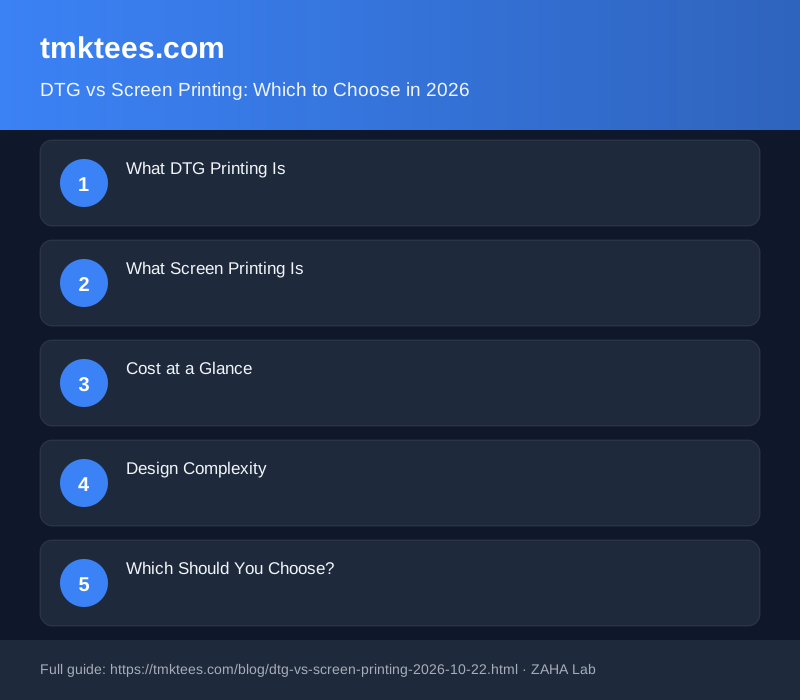
Nearly half of first-time print buyers overpay because they choose the wrong method for their order size. DTG printing beats screen printing for orders under 25 pieces and for artwork with gradients or photographs. Screen printing wins at 50 or more pieces, cutting per-unit cost by up to 40%. Those two facts cover most decisions.
What DTG Printing Is
Direct-to-garment printing jets water-based ink straight onto the fabric. The machine works like a desktop inkjet printer, except it handles a T-shirt rather than paper. No screens. No setup charge per colour. One custom tee costs almost the same to produce as ten, which is why DTG is the standard for short-run personalised tees and one-off gifts.
The practical limits: DTG works best on 100% ring-spun cotton at 180-200 gsm. Polyester blends repel the water-based inks. Printing on black garments requires a white underbase, which adds print time and cost. For photographic detail, multi-colour gradients, or any design with more than four colours, DTG still comes out cheaper at low quantities. The Gildan Softstyle T-Shirt multipack is one of the most widely used DTG blanks in the UK: 153 gsm, ring-spun, and it takes ink cleanly across the full colour range.
What Screen Printing Is
Screen printing burns a stencil onto a mesh screen, then pushes ink through it onto the fabric. Each colour in your design needs its own screen. Setup costs run roughly £15-25 per screen at most UK print shops. A four-colour logo means four screens and £60-100 in setup before a single garment is printed.
That upfront cost gets divided across your run. At 100 pieces, £80 in setup adds just £0.80 per shirt. Plastisol inks sit on top of the fibres rather than bonding within them, producing brighter results on dark fabric and prints that hold their colour for 150+ washes. For hoodies, the Gildan 18500 Heavy Blend Hoodie at 280 gsm is one of the most screen-printed blanks in the UK and holds both ink types well.
Cost at a Glance
| Order size | DTG | Screen printing |
|---|---|---|
| 1-24 pieces | Lower per-unit cost | Setup cost per unit is high |
| 25-49 pieces | Similar | Similar |
| 50+ pieces | Higher per-unit cost | Lower per-unit cost |
These figures apply to a two-colour design on a white base. Dark garments and premium blanks push costs up for both methods.
Design Complexity
DTG handles full CMYK images, photographic artwork, and fine gradients without any extra cost. Screen printing requires separating artwork into spot colours, one layer per screen. A five-colour design is five screens. If your logo is a single Pantone shade on a white or light base and you are ordering in volume, screen printing almost certainly wins. If your design looks like a photograph, use DTG.
Which Should You Choose?
Order under 30 pieces, or have complex artwork? DTG. Order 50 or more pieces with a simple, bold logo? Screen printing saves money and lasts longer. For custom streetwear drops where you want premium soft-hand feel and high colour vibrancy, look at blanks such as the Fruit of the Loom Classic Hooded Sweatshirt, which suits both methods and is widely available in UK wholesale quantities.
One edge case worth naming: all-over print streetwear with sublimated graphics requires dye-sublimation, not DTG or screen. That only works on white polyester. It is a different process entirely and a separate conversation.
FAQ
Is DTG printing good quality?
Yes, on 100% cotton with correct pre-treatment and curing. A well-executed DTG print matches screen printing for colour accuracy and detail on light garments. Quality drops on polyester blends or if the garment skips the pre-treat step.
How many washes does a DTG print last?
A properly cured DTG print typically holds for 60-80 washes before visible fading. Washing inside-out at 30°C extends that noticeably. Screen prints on 100% cotton generally outlast DTG by 50-70 washes under the same conditions.
What is the minimum order for screen printing?
Most UK print shops require a minimum of 12-24 units for screen printing because setup costs do not make sense at smaller quantities. Below that threshold, DTG or heat-transfer vinyl is the more cost-effective route.
Can you screen print on a hoodie?
Yes. Screen printing works well on 280-350 gsm cotton-polyester blend hoodies. Curing at the correct dwell temperature locks the plastisol ink onto the fleece and keeps it wash-resistant. DTG on thick fleece can struggle because the textured surface interrupts the inkjet pass.
What file format do I need for each method?
DTG accepts high-resolution JPEG or PNG at 300 dpi minimum, because it prints the full CMYK image as-is. Screen printing requires vector artwork in AI or EPS format with colours separated as Pantone references, one layer per colour. Submitting a JPEG for a screen print order is the single most common cause of delays at UK print shops.