All-Over Print T-Shirts: What to Know Before You Order
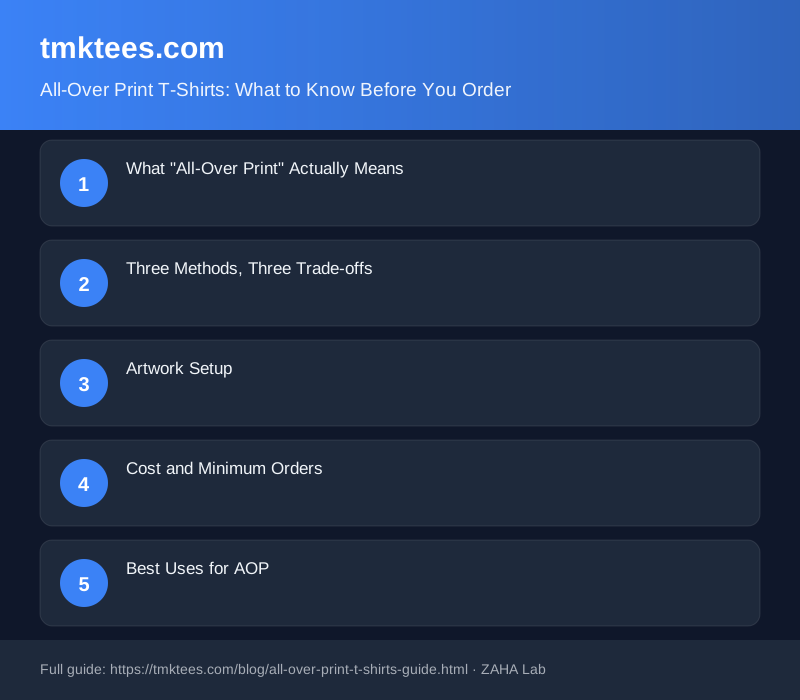
What "All-Over Print" Actually Means
A standard chest print occupies a roughly 30x40cm panel at the front of a garment. All-over print covers the entire surface: front, back, sleeves, collar area, and ideally across seams. The garment looks as though it was woven from the design itself. That effect demands a completely different production process, not just a larger platen.
Three Methods, Three Trade-offs
Sublimation is the most widely available AOP method in the UK. Ink converts to gas under heat and bonds directly into polyester fibres. The result is vivid, permanent colour with zero hand feel. Two non-negotiables: the base fabric must be at least 80% polyester, and the garment must start white or very pale grey. Dark-base AOP via sublimation is not possible because the dye is semi-transparent.
Cut-and-sew prints flat fabric rolls before cutting and assembling the garment. Seam alignment is precise. It works on polyester and poly-cotton blends and is the standard method for branded streetwear drops. Minimum orders usually start at 50 pieces; lead times run 3 to 6 weeks depending on the factory.
All-over DTG exists but has real limitations. Most commercial platens cap at 40cm wide, so true edge-to-edge coverage is difficult. Colour saturation runs lower than sublimation. For a one-off test print on a cotton garment it is usable. For a finished product intended for sale, it rarely matches the other two methods.
Artwork Setup
Sending the wrong file is the most common and most expensive mistake in AOP orders.
- File format: PNG or PDF, in RGB colour mode, not CMYK
- Resolution: 150 DPI at actual print dimensions as a minimum; 300 DPI for sharp results
- Bleed: extend your design 15 to 20mm beyond the garment edge in your template file
- Avoid fine text below 10pt near seam lines; cut-and-sew assembly shifts panels by 2 to 5mm
Colour mode matters a lot. Sublimation reproduces RGB values accurately because it bypasses the CMYK conversion step entirely. Submit a CMYK file and your oranges will arrive as muddy browns.
Cost and Minimum Orders
Single-piece AOP sublimation tees from UK on-demand services typically run £18 to £28 each, depending on complexity and blank choice. The AWDis Just Cool Performance T-Shirt is a popular printing blank for sublimation runs: 100% polyester, good drape, and available in white for direct dye sublimation. It is widely stocked and prints consistently.
Cut-and-sew at 50 pieces can bring unit cost down to £12 to £18, but expect a sampling and setup charge of £80 to £150 on your first order. The same economics apply to all-over print custom hoodies: polyester-dominant fabric, RGB file, and confirmed seam coverage agreed with your printer before final approval.
Best Uses for AOP
Repeating tile patterns handle seam shifts far better than large-scale single images. Festival merch, sports kits, and streetwear drops all suit AOP well for this reason. If your design relies on a centred photographic image, standard DTG or screen print is the more reliable choice.
For gradient-heavy or photorealistic designs on a full garment, sublimation on a lightweight personalised unisex performance tee is the most direct route to that result, with no screen print set-up fees and no colour separation costs.
FAQ
Can you do all-over print on a 100% cotton t-shirt?
Not via sublimation. Sublimation dye only bonds to synthetic fibres, so a cotton shirt will produce faded, washed-out results. For cotton AOP, cut-and-sew with reactive or pigment printing is the correct method, though minimum orders are higher.
What is the minimum order for all-over print t-shirts?
For sublimation on-demand, most UK printers accept single-piece orders. Cut-and-sew production typically starts at 50 pieces. Some factories allow 30-piece runs with a small-order surcharge, but under that quantity sublimation on-demand is almost always cheaper per unit.
Why are my AOP t-shirts coming out faded or dull?
The two most common causes are a cotton-rich fabric (sublimation needs polyester) and a CMYK artwork file submitted to a sublimation printer. Check the fabric composition of your blank and confirm your design file is in RGB before reordering.
Do all-over print t-shirts fade in the wash?
Sublimation AOP is one of the most wash-resistant printing methods available because the dye bonds inside the fibre rather than sitting on the surface. Wash at 30 degrees, turn inside out, and avoid tumble drying at high heat to maintain colour for 100-plus washes.
How do I prepare my artwork file for all-over printing?
Export as a high-resolution PNG or PDF in RGB colour mode, at a minimum of 150 DPI at the actual print size. Add 15 to 20mm of bleed beyond the garment edges using the template provided by your printer. Avoid placing critical design elements such as text or faces directly on a seam line.