Choosing the Right Blank T-Shirt for Custom Printing
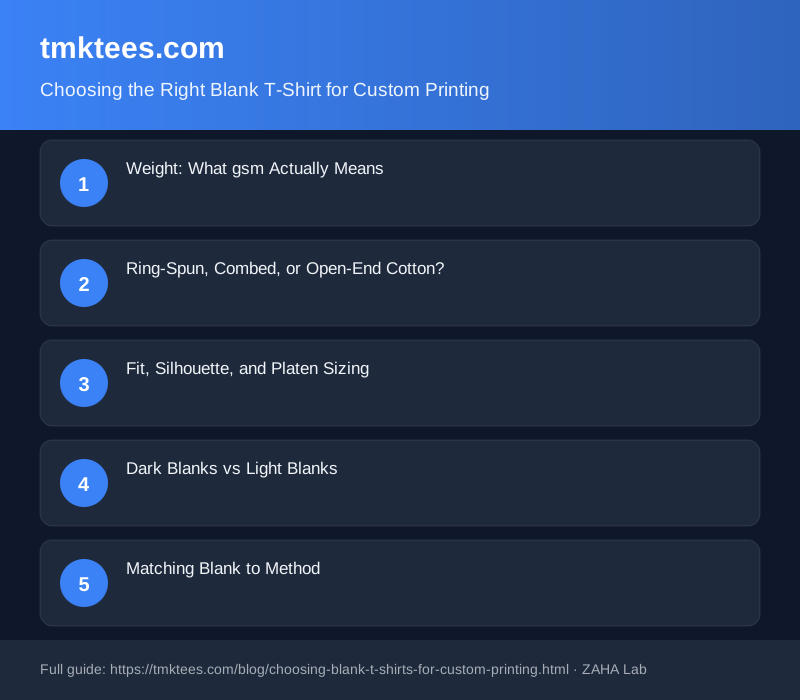
Most buyers spend an hour choosing a print method and 30 seconds picking the blank. That single choice controls roughly 40 per cent of how the finished shirt looks, feels, and holds up after 50 washes.
The short answer: For most custom t-shirt orders, a 160-190gsm ring-spun cotton blank is the right starting point. It takes ink cleanly, holds its shape after washing, and works with every mainstream print method: screen printing, DTG, heat transfer, and DTF.
Weight: What gsm Actually Means
Fabric weight is measured in grams per square metre. Lighter blanks below 150gsm drape softly and suit summer ranges, but thin fabric shows DTG ink bleed more easily on fine-detail work. Mid-weight blanks at 160-200gsm are the industry standard. Anything above 220gsm is heavy-duty territory, better suited to embroidery and workwear than standard apparel printing.
A 180gsm tee such as the Gildan Softstyle 64000 prints consistently across DTG and screen print runs without puckering or ink migration. It is one of the most widely used blanks for a reason.
Ring-Spun, Combed, or Open-End Cotton?
Open-end (OE) cotton is spun quickly and costs less. It prints adequately for basic designs, but the rougher surface creates visible grain on fine-detail artwork. Ring-spun cotton produces a smoother yarn, giving sharper print edges. Combed ring-spun goes further: short fibres are removed and the remainder aligned, leaving the cleanest printing surface of the three.
For streetwear with detailed graphics, gradients, or photographic prints, combed ring-spun blanks consistently outperform OE. The difference is visible at arm's length on anything with linework finer than 1mm.
Fit, Silhouette, and Platen Sizing
Oversized blanks dominate streetwear right now. The wider body and dropped shoulder do not affect print quality on chest or back panels. Where it matters: sleeve-placement prints and wrap-around graphics can shift if the platen does not seat the garment flat. Always confirm your printer's platen dimensions before ordering oversized cuts in any real volume.
The same logic applies to custom hoodies for printing: fabric weight and fibre type govern print quality far more than silhouette does. A 280gsm combed-cotton hoodie prints cleaner than a 220gsm OE version, consistently.
Dark Blanks vs Light Blanks
White and light-coloured blanks let ink colours sit true. Dark blanks require an underbase layer in screen printing, or a white underlay pass in DTG. Both add cost and increase the hand-feel thickness of the print. Budget for the extra pass if your range skews dark, and factor in a 10-15 per cent increase in unit cost from the start.
For high-volume runs where cost-per-unit is the priority, lighter blanks such as the Fruit of the Loom Valueweight Tee work well with screen printing, where ink laydown is controlled and predictable regardless of blank tier.
Matching Blank to Method
| Print method | Recommended blank |
|---|---|
| DTG | Combed ring-spun, 100% cotton or 85/15 cotton-poly, 160-190gsm |
| Screen printing | Any ring-spun blank; heavier gsm gives a crisper ink deposit |
| Heat transfer / DTF | Blends acceptable; avoid high-poly counts if wash durability is a priority |
| Embroidery | 200gsm+ to resist puckering; lightweight tees need stabiliser backing |
One final point: request a printed sample before committing to a bulk run. A 5-unit test order on your chosen blank reveals ink adhesion, colour accuracy, and hand-feel in under a week. It costs far less than reprinting 200 units.
FAQ
What gsm is best for custom t-shirts?
160-190gsm covers most use cases. Below 150gsm risks showing ink bleed on DTG prints; above 220gsm suits embroidery and workwear rather than standard apparel printing.
Can any blank be used for DTG printing?
No. DTG works best on 100% cotton or high-cotton blends. Polyester content above 50% causes dye migration, where the fabric colour bleeds into the ink layer during curing and muddies the result noticeably.
Does ring-spun cotton make a visible difference to print quality?
Yes, particularly on detailed artwork. The smoother surface reduces ink spread, giving finer lines and more accurate colour reproduction compared with open-end alternatives. For photographic or gradient designs the difference is significant enough to justify the small cost premium.
Are oversized tees harder to print on?
Not inherently. The challenge is placement accuracy, not the fabric. Larger bodies need wider platens to hold the garment flat during printing. Confirm platen dimensions with your printer before placing a bulk order in oversized cuts.
Does fabric blend affect how long a custom print lasts?
Higher polyester content can cause colour fading under repeated hot washing. For maximum longevity, turn printed garments inside out and wash at 30 degrees Celsius, regardless of blank type or print method.