Colour Matching for Custom T-Shirts Explained
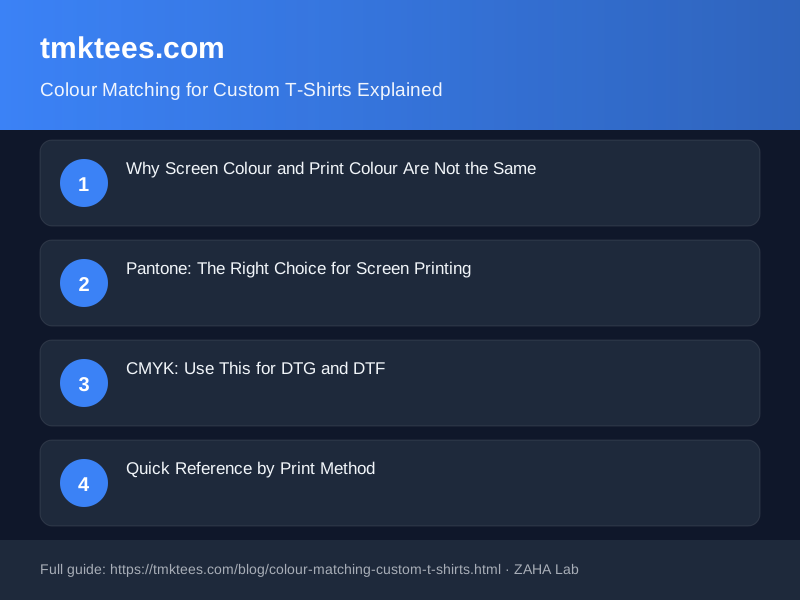
Roughly one in three custom print jobs we see arrive with artwork in the wrong colour mode. The fire-engine red on your screen prints as a dull terracotta on the finished shirt, and the client wonders why.
Why Screen Colour and Print Colour Are Not the Same
Monitors emit light. They mix red, green, and blue to produce colour. Printers absorb light using cyan, magenta, yellow, and black inks on a surface. The two systems share a large overlap, but vivid neons, electric blues, and saturated greens exist only in the RGB range. Print them and they go flat.
Garment printing adds a second variable: the fabric itself. A white tee will reproduce CMYK values accurately on a well-calibrated DTG machine. Run the same design on navy and every colour shifts, because the inks are semi-transparent and the dark base shows through.
Pantone: The Right Choice for Screen Printing
Pantone Matching System (PMS) colours are pre-mixed inks, not digital values. Each has a unique reference number. PMS 485 C is the same red whether the job runs in Leeds or Los Angeles. The screen printer mixes or orders that exact ink and the result is predictable every time.
Give the printer a PMS code, not a hex value. Hex codes are RGB. A screen printer has no use for them without manual conversion, and that conversion introduces error. This matters most for brand work. If your streetwear label has a signature colour, locking it to a PMS number protects it across every personalised t-shirt and custom hoodie in your range. It costs nothing extra to specify and saves a lot of back-and-forth at approval stage.
CMYK: Use This for DTG and DTF
Direct-to-garment and direct-to-film printers use CMYK ink sets. Submit artwork as a CMYK PDF or TIFF at 300 DPI at final print size. If you send an RGB file, the RIP (raster image processor) software converts it automatically. You lose control of how colours shift in that translation.
One practical step: in Photoshop, go to Edit, then Convert to Profile, and select Coated FOGRA39 before exporting. That is the standard European press profile. It is not a perfect match for garment inks, but it gets you closer than a default RGB-to-CMYK conversion.
Quick Reference by Print Method
| Method | Colour Mode | File Format |
|---|---|---|
| Screen printing | Pantone (PMS C or U) | AI, EPS, PDF vector |
| DTG | CMYK, 300 DPI | PDF, TIFF, PNG |
| DTF | CMYK, 300 DPI | PDF, TIFF, PNG |
| Sublimation | RGB (printer ICC profile) | PDF, PNG |
Sublimation is the exception. Because it converts ink directly into polyester fibres via heat, it uses specialist ICC profiles that sit closer to the RGB space. If you are ordering sublimation tees, ask the printer which profile they prefer before finalising your file.
FAQ
Why does my printed t-shirt look different to my design?
Your artwork was almost certainly built in RGB, which monitors display accurately but printers cannot reproduce directly. Converting RGB to CMYK or screen ink reduces the colour gamut, particularly for neons and saturated greens or blues. Rebuilding key colours in CMYK from the start solves this for most designs.
Can I match a specific brand colour exactly on a custom tee?
Yes, if you use screen printing and supply a PMS code. DTG can get close but offers no guarantee because the ink sits on top of fibres rather than being pre-mixed to a fixed formula. For brand-critical colours, screen printing with a specified PMS is the only reliable route.
What Pantone colours work best on dark-coloured shirts?
Lighter PMS shades printed directly onto dark fabric look washed out because they lack opacity. Ask your printer to apply a white underbase first. That adds one extra screen to the job and a small cost, but it makes light colours print true on black, navy, or forest green garments.
Do DTG printers use Pantone?
No. DTG machines use CMYK ink sets (some add extra channels for a wider gamut), so they cannot replicate a Pantone value exactly. Many operators use a published Pantone-to-CMYK conversion chart to get as close as possible, but expect a slight variance, particularly on saturated reds and oranges.
What resolution should custom t-shirt artwork be?
300 DPI at the final print size is the standard minimum for DTG and DTF. Screen printing is vector-based so resolution is not relevant, but all text must be outlined and all strokes expanded before submitting the file, otherwise fonts and line weights may change when the printer opens it.
Related Products
Essential reference for specifying PMS colours on fabric and fashion projects before sending artwork to print.
View on Amazon UK →Popular white and coloured blanks for personalised tees; widely used to proof colour output before larger runs.
View on Amazon UK →50/50 fleece blank used across custom streetwear hoodie runs; available in 30+ colours for consistent branding.
View on Amazon UK →