Embroidery vs Print: Best for Custom Apparel?
Affiliate disclosure: some links in this article are affiliate links. If you buy through them, we may earn a small commission at no extra cost to you.
Embroidered logos outlast printed ones by an average of 50 washes on structured fabrics. Most people choose their decoration method last, which is exactly why they so often choose the wrong one.
For custom t-shirts and hoodies with large, colourful graphics, printing is the right call: lower cost per piece, unlimited colour range, and photographic detail. Embroidery suits polo shirts, caps, and workwear jackets where a raised, tactile finish matters and the design stays compact.
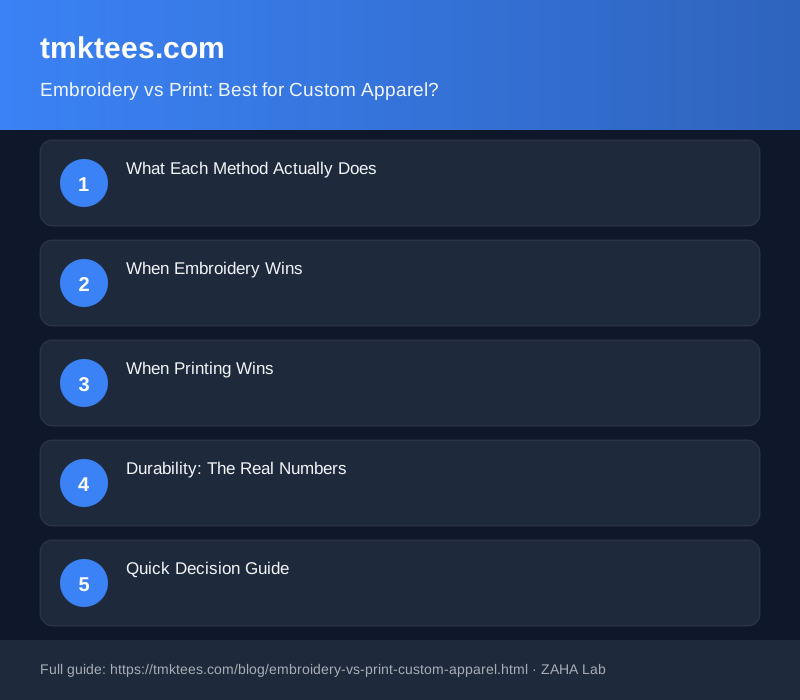
What Each Method Actually Does
Printing deposits ink, dye, or transferred film directly onto the fabric surface. Screen printing, DTG, and DTF all fall under this umbrella. The result sits on top of the fibres.
Embroidery stitches thread through the garment with a needle. A digitised file tells the machine exactly where each stitch lands. The design becomes part of the fabric structure. That single difference explains every trade-off below.
When Embroidery Wins
Workwear, sports kits, and premium branded merchandise lean on embroidery for good reason. A chest logo on a polo shirt takes roughly 5,000 to 8,000 stitches and survives industrial laundering without cracking or fading. Caps are another natural fit: flat, structured brims accept embroidery well, and printing on a rigid peak rarely looks clean at close range.
The catch is cost. Digitising a new design runs between £15 and £50 as a one-off setup charge. Per-piece pricing drops at volume, but orders under 24 units can feel expensive. Avoid embroidery for runs below 12 pieces unless budget is not a constraint.
When Printing Wins
A full-chest graphic on a Gildan Heavy Cotton t-shirt is where printing excels. You can reproduce photographic images, colour gradients, and fine line art at a fraction of the cost per piece. DTG printing handles short runs of 1 to 50 units without any setup fee.
Streetwear drops live and die by bold graphics. If your design covers more than 15 cm or uses more than 6 colours, printing is almost always the practical answer. Custom hoodies follow the same logic: a large back graphic on a Fruit of the Loom Classic Hooded Sweatshirt costs far less than the equivalent built from thread.
Durability: The Real Numbers
Embroidery generally survives 100 or more wash cycles without visible deterioration on tightly woven fabrics. Thread does not crack or peel. Screen printing with plastisol ink holds well past 50 washes when applied correctly. DTG prints on 100% cotton can fade noticeably after 30 to 40 washes if the pre-treatment step is skipped.
On soft, loosely woven fabrics like tri-blend tees, embroidery can cause puckering. The tension of the stitches pulls at the weave. Printing is gentler on those materials.
Quick Decision Guide
- Design smaller than a credit card, on a structured garment: embroidery.
- Design larger than 10 cm, photographic, or with more than 6 colours: printing.
- Order under 12 units: printing (sidestep the digitisation setup cost).
- Order over 100 units with a simple logo: compare both on price per piece.
- Cap or polo shirt: embroidery by default.
- T-shirt or hoodie with streetwear graphics: printing by default.
The strongest custom apparel lines often use both. A small embroidered chest hit on a heavyweight hoodie blank, paired with a printed back graphic on something like the Stanley/Stella Cruiser organic hoodie, gives you a product that justifies a higher retail price without betting entirely on one technique.
FAQ
Is embroidery more expensive than printing?
For small orders, yes. Digitising a new design costs £15 to £50 as a one-time fee, and per-piece rates are higher than basic printing. At volumes above 100 units with a simple logo, the cost gap narrows considerably.
Can you embroider on a t-shirt?
Yes, but soft, stretchy jersey fabrics need a stabiliser backing to prevent puckering. A small left-chest logo works well. A large full-chest design does not: the weight and tension of the stitching distorts the fabric in ways that cannot be reversed.
Which lasts longer, embroidery or printing?
Embroidery outlasts most printing methods on structured fabrics because thread does not crack or peel. Well-applied screen printing comes close. DTG can fade faster if the garment is washed frequently without following the care label.
What is the minimum order for embroidery?
Most UK suppliers accept orders from 1 unit, but the digitisation charge makes very small runs expensive per piece. Orders of 12 or more spread that setup cost into an acceptable range. Many suppliers waive the fee entirely above 50 units.
Can embroidery reproduce a photographic image?
No. Thread limits tonal range and fine detail considerably. Embroidery works best with clean, bold shapes and a maximum of around 15 thread colours. For photo-realistic prints, DTG or DTF printing is the only practical option.