Sublimation Printing for Custom T-Shirts Explained
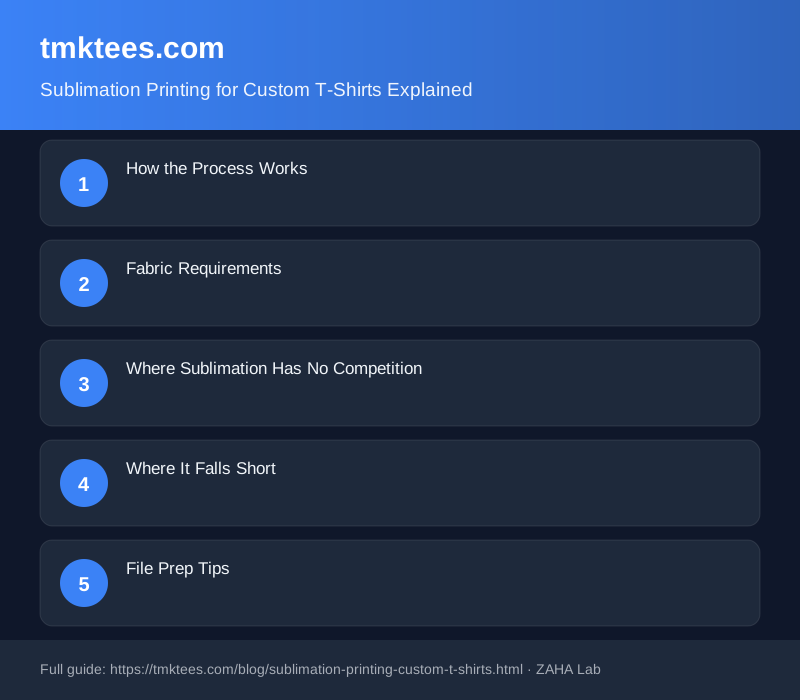
Every other printing method sits on top of your fabric. Sublimation goes inside it, which changes what's possible, what's not, and which garments will actually work.
How the Process Works
A solid dye is printed onto transfer paper, then pressed against the garment at around 200 °C. At that temperature the dye skips the liquid stage and converts straight to gas, pushing into open polyester polymer chains. When the press lifts and the fabric cools, those chains lock the dye inside permanently. There is no layer sitting on top, so the hand feel of the fabric is completely unchanged.
Fabric Requirements
Sublimation trips most people up here. Because the dye bonds with polyester molecules specifically, cotton fibres have no receptor for it. Print onto a 100% cotton tee and the result will look faded and wash out within a handful of cycles. For reliable, vivid results the blank needs to be at least 65% polyester, ideally 100%.
A popular starting point is the Gildan Performance Adult T-Shirt, a 100% polyester blank built for sportswear that accepts sublimation dye exceptionally well. White and very pale bases are also mandatory. Sublimation dye is transparent, so a dark garment will show nothing at all.
Where Sublimation Has No Competition
All-over printing. Screen printing is not practical on finished garments edge to edge, and DTG leaves a visible print boundary where the head stops. Sublimation covers every centimetre of fabric including around seams, with no colour drop-off. For custom sportswear, festival pieces, or commission streetwear built around full-coverage graphics, no other method delivers the same result.
Unit economics also favour short runs. Equipment aside, printing one piece costs nearly the same as printing fifty, because there are no screens to set up and no ink heads to prime per job. That makes it a practical choice for one-off personalised pieces or small-batch custom printed hoodies where screen printing's setup costs would be hard to justify.
Where It Falls Short
Dark or black garments are simply not an option. Nor is 100% cotton, which rules out many of the most popular blank brands. If your customers are set on a specific ring-spun tee or fleece-back hoodie in a cotton-rich blend, DTG or screen printing will serve them better. Sublimation also requires artwork files to be mirrored before printing; skipping that step reverses all text in the finished garment.
File Prep Tips
Use RGB colour mode, not CMYK. Sublimation printers read RGB values directly, and an unnecessary CMYK conversion dulls saturated tones. Set the canvas to the garment's actual dimensions at 150 DPI minimum, leave bleed on all four edges for all-over designs, and mirror the file before submitting. Getting those four points right eliminates the most common reprinting errors.
FAQ
Can you sublimate onto a 50/50 cotton-polyester blend?
You can, but expect muted, washed-out colour rather than vivid results. Only the polyester fibres hold the dye, so a 50/50 blend produces roughly half the saturation of a 100% polyester blank. Some printers intentionally use this for a vintage faded effect, but it is not the right choice for graphic-heavy designs.
Does sublimation printing fade in the wash?
Not under normal conditions. Because the dye is locked inside the polyester fibres rather than sitting on top, it resists washing far better than heat transfer or screen print over time. Quality polyester blanks routinely hold colour past 50 wash cycles without meaningful fading.
Is sublimation more expensive than DTG printing?
Per unit, costs are broadly comparable for single pieces. At volume, sublimation becomes cheaper because there are no ink heads to maintain and no per-job consumable spikes. DTG has higher ongoing ink costs but works on cotton, and quality cotton blanks are generally cheaper than equivalent polyester ones.
Can you sublimate on black or dark-coloured t-shirts?
No. Sublimation dye has no opaque or white base, so on a dark garment the print is invisible. All-over sublimation requires a white or very light-coloured blank. If a dark base is essential, DTG with a white underbase layer or screen printing are the correct methods.
What file format should I supply for sublimation printing?
For placement prints, a high-resolution PNG with a transparent background works well. For all-over designs, supply a TIFF or PDF at full garment dimensions in RGB mode. Always confirm the exact pixel dimensions and bleed specification with your printer before sending final files.
Related Products
100% polyester blank built for all-over sublimation printing.
Popular blank for personalised custom hoodie projects.
Ring-spun cotton staple for DTG and screen-print custom streetwear.